

A record for one cloud of atoms
Imagine trying to slow down a swarm of invisible particles. They constantly change position, every unwanted collision disturbs them, and Earth’s gravity pulls them downwards. To observe them almost at rest for long enough, building a better refrigerator is not sufficient. You need to redesign how you hold, cool and measure them, then send the entire laboratory into orbit.
That is the background to a result published by a team of Chinese researchers in Science on November 5, 2026. In an experiment aboard Tiangong, using equipment in the Mengtian laboratory module, they prepared an ultracold atomic gas with an equivalent temperature of approximately 9.7 . A picokelvin is one trillionth of a kelvin, making this just 0.0000000000097 K above .
The value is approximately four times lower than the previously reported 38 achieved in a free-fall experiment on Earth. The new work is about more than a smaller number, however: the researchers tracked the cloud’s expansion for seven seconds using a system that offers different ways to control atoms. In this field, those few additional seconds can make a substantial difference.
What does it actually mean for something to be cold?
When we heat the air in a room, its molecules move faster on average. Cooling slows this disordered motion. In a simple gas, temperature therefore directly describes the average energy of the particles’ random motion. Quantum gases require a more careful description, but the same basic idea helps us understand why physicists want atoms to move as slowly as possible.
In everyday life, we use the Celsius scale, whose zero is associated with water freezing under ordinary conditions. The begins at : 0 K corresponds to −273.15 °C. A difference of one kelvin equals a difference of one Celsius degree; the scales have different starting points. Thus 20 °C corresponds to 293.15 K.
A microkelvin is a millionth, a nanokelvin a billionth, and a picokelvin a trillionth of a kelvin. The new result belongs to the last of these ranges. Comparing it with room temperature gives a number about thirty trillion times smaller on the absolute scale, but this ratio describes the energy of the measured atomic cloud, not a room that we could touch.
A number that needs careful reading
9.7 pK denotes an equivalent temperature inferred from the atomic cloud’s expansion. It is not the temperature of the whole space station, the or the air inside it. In a laboratory, an extremely cold sample can sit inside an instrument whose components have entirely ordinary temperatures.
Why did the scientists choose rubidium?
is a metal that looks very different in bulk from the dilute cloud of atoms used in this experiment. For this kind of research, a small number of its atoms are isolated, then their motion is controlled using light and other carefully adjusted influences. Its atomic properties are well studied and suited to cooling and trapping techniques developed over several decades.
A cloud of about 20,000 atoms is an extraordinarily small sample compared with any everyday object. Even so, it contains enough particles for physicists to study matter’s collective behaviour. Protecting them from their surroundings is crucial: a single collision with a much more energetic particle can spoil the carefully prepared conditions.
Such experiments therefore take place in a , from which most of the gas has been removed. It does not provide cooling by itself, but it dramatically reduces unwanted collisions. Only in such an isolated environment can laser beams and traps take control of the atomic cloud.
NASA/JPL-Caltech · Sources ↗ · Image terms ↗
How can light provide cooling?
We usually associate light with heating: sunlight warms our faces, and a powerful laser can cut through material. uses light differently. The aim is not to illuminate an object as strongly as possible, but to make atoms absorb light from a laser beam under precisely chosen conditions.
Light carries energy and momentum in packets called . When an atom moving towards a laser beam absorbs an appropriate , it receives a tiny push against its direction of travel. It then emits a in a random direction. After many such cycles, with the beams arranged appropriately, the random contributions from emission average out while the directed braking accumulates.
Selecting the right light frequency matters: an atom does not absorb just any . Tuning the light slightly below the appropriate atomic resonance can make atoms travelling towards the beam absorb it more efficiently. Light thus becomes a finely controlled brake on atomic motion. This picture explains the start of the process; reaching the lowest energies requires several successive techniques.
A light trap and an exit for the fastest atoms
Cold atoms must be held in place without touching the container’s walls. An uses the effect of a carefully focused laser field to do this. With the right settings, it creates a region where atoms can remain, like a shallow valley that is difficult to escape. Crossed laser beams play a central role in the Chinese experiment.
Next comes : the trap is adjusted so that the most energetic atoms can leave more easily. The remaining atoms then redistribute energy among themselves, lowering its average value. The principle resembles water cooling through evaporation, although this involves the controlled loss of atoms from a very dilute gas rather than a droplet of liquid.
The final steps also change the way the trap confines the cloud. Broadening and weakening a suitably shaped trap can further reduce the energy of the cloud’s subsequent expansion. The team used two stages with different widths of crossed laser beams. Stable laser light, precise trap control and suppression of mechanical vibrations were all important to the result.
When many atoms begin to behave as one quantum system
In our everyday picture, a gas consists of many separate particles moving chaotically. At sufficiently low temperatures, with a suitable density and type of atom, that picture is no longer enough. Many atoms can occupy the same quantum state and form a . Their collective wave-like behaviour then becomes available for direct experimental study.
This does not mean the atoms have chemically joined into one giant atom. They remain atoms, but a coordinated quantum state describes them, allowing certain properties of the entire cloud to be studied as the behaviour of a shared matter wave. This is precisely why condensates are used to investigate phenomena that would be much harder to distinguish in a warmer, more disordered sample.
The idea originated in theoretical work by Satyendra Nath Bose and Albert Einstein in the 1920s. The first condensates in dilute atomic gases were produced in 1995, and the Nobel Prize for this line of research was awarded in 2001. Eric Cornell, Carl Wieman and Wolfgang Ketterle helped turn a theoretical prediction into an experimental tool. Today’s experiments in orbit continue that story.
NASA/JPL-Caltech · Sources ↗ · Image terms ↗
Why did the laboratory need to go into orbit?
On Earth, gravity constantly pulls the atomic cloud downwards. If the trap is weakened substantially, atoms may fall out of the region where they can be controlled; if it is switched off, they fall towards the chamber’s bottom. There is therefore a practical limit to how long they can be observed without additional confinement and the unwanted effects of those forces.
In orbit, the station, instrument and sample continuously fall freely around Earth together. Gravity still exists there and keeps the station on its trajectory. Because the whole system falls together, however, its interior experiences : the sample does not have the same apparent weight and support as a laboratory on the ground. This is the fundamental reason astronauts float.
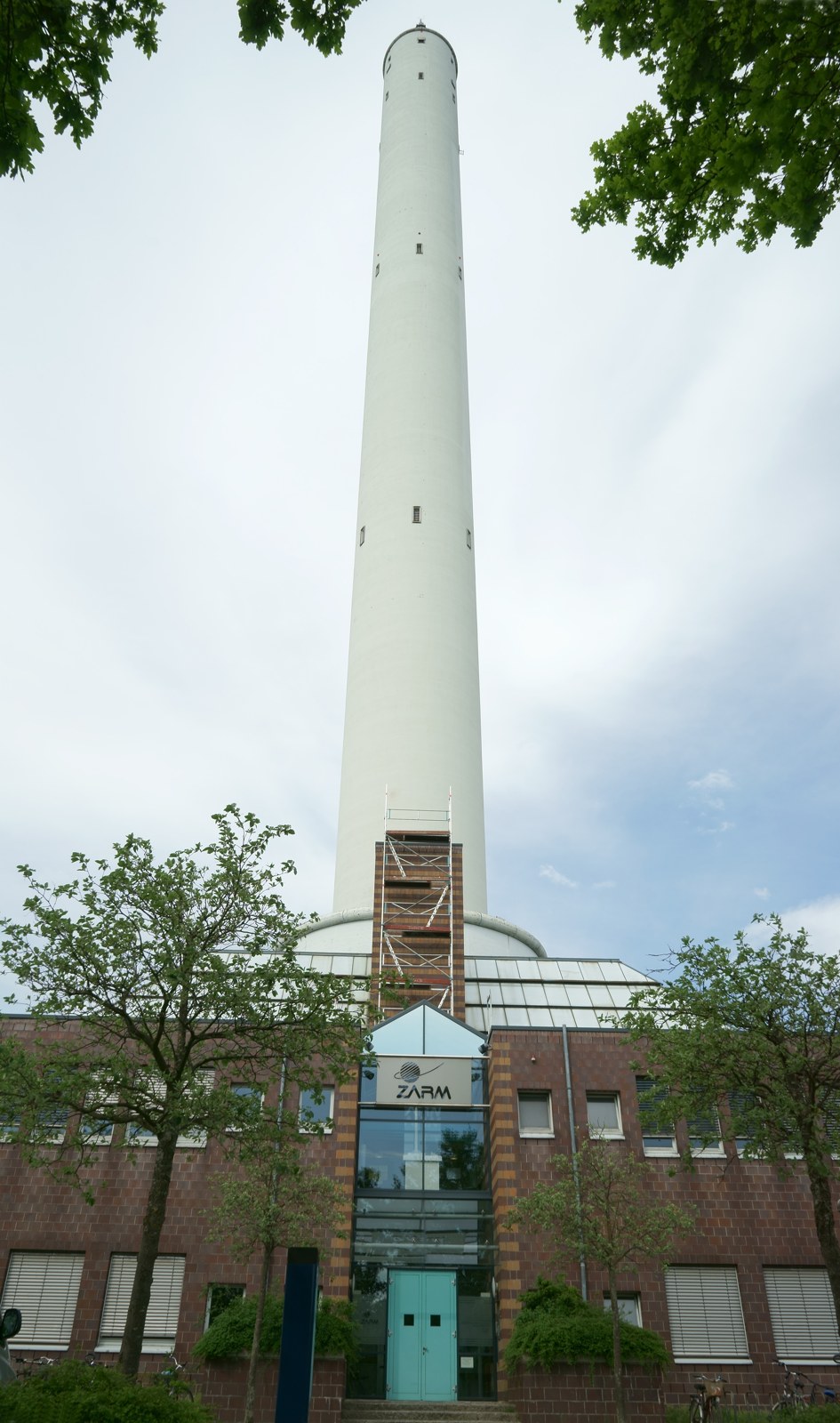
For an atomic cloud, this allows much weaker confinement and more time for free expansion within the instrument after release. We can briefly create a similar condition on Earth in drop towers. An orbital laboratory makes it possible to perform and repeat these experiments without the same restriction imposed by the duration of a single fall through a tower.
Jürgen Howaldt / Wikimedia Commons · Sources ↗ · Image terms ↗
How do you measure a temperature for which there is no thermometer?
Nobody inserts a tiny mercury thermometer into this cloud. Researchers prepare the atomic sample, release it from suitable confinement, and track how its size changes with time. Particles with a broader spread of velocities disperse the cloud faster; slower expansion indicates less energy in this motion.
This is why the paper refers to an equivalent temperature: the measured expansion energy is expressed on a temperature scale. For a condensate, where quantum properties and interactions between atoms matter, this is a more precise statement than a simple picture of a gas in complete thermal equilibrium. The value of 9.7 should therefore be read alongside the measurement method and its uncertainty.
Even at , we should not imagine all quantum motion disappearing like the movement of a stopped mechanical clock. Quantum systems can have ground-state energy and properties that rule out this classical picture of rest. The record should therefore be understood as a very small energy for a particular, carefully measured motion, and as an achievement in controlling the sample.
What is such a cold cloud useful for?
The more slowly an atomic cloud expands, the longer it remains suitable for carefully performing and reading an experiment. Scientists can shape its environment and explore how particles respond collectively. Within a controlled sample, they can imitate and study complex behaviours of matter that are difficult to calculate or investigate directly in other materials.
Another important direction involves . Atoms’ wave-like behaviour allows quantum paths to be split and compared again, while the effects of acceleration and gravity leave a trace in the result. Colder samples and longer observation times can support these precise measurements. This is why cold atoms in orbit are associated with future gravity sensors and tests of fundamental physical laws.
One possible objective is to test whether different samples fall freely in the same way under identical conditions, as our existing description of gravity predicts. The new temperature result is not itself such a test or evidence of new physics. It prepares better experimental conditions in which these and other questions could be investigated.
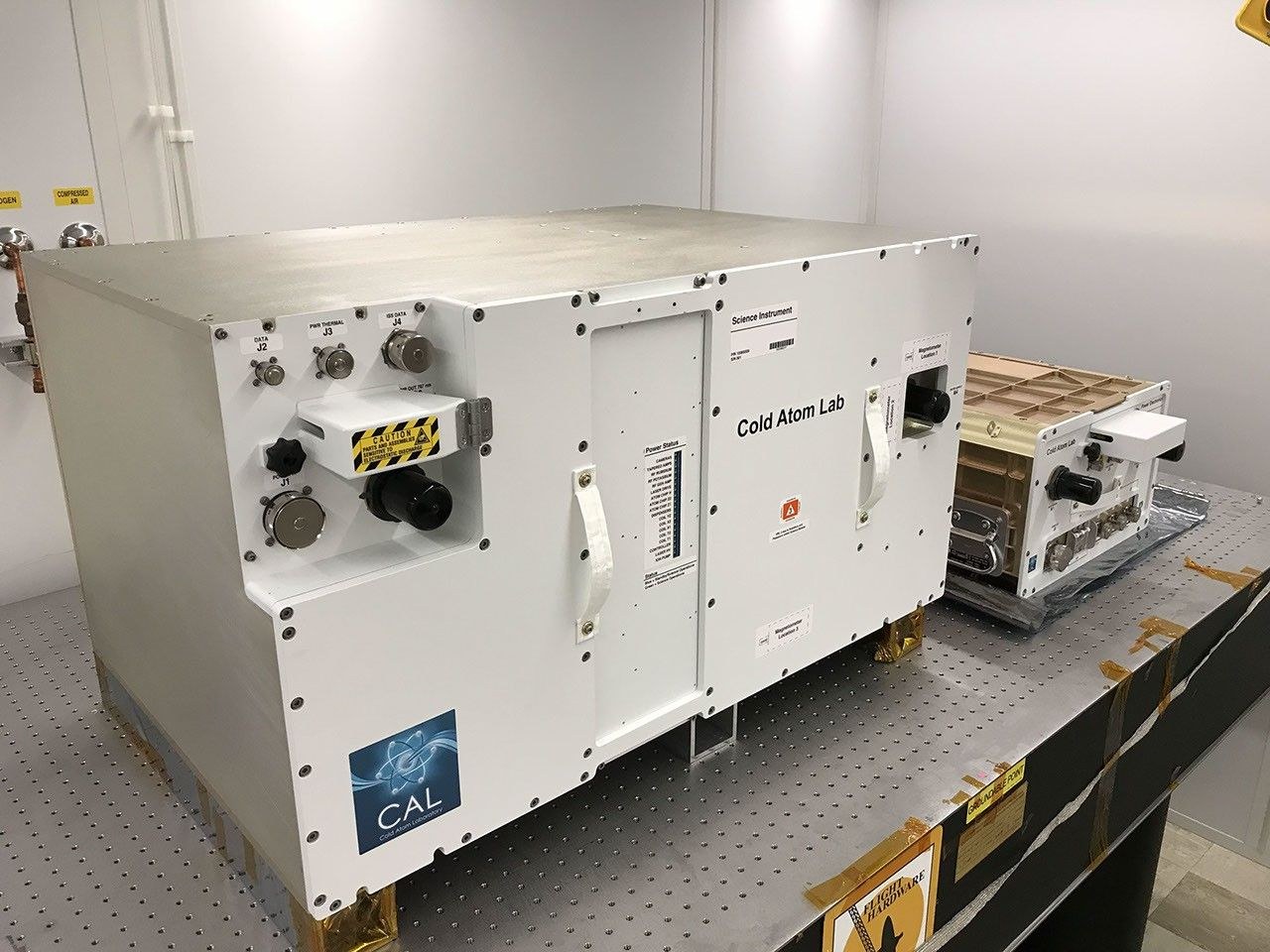
An important predecessor is aboard the International Space Station, where the American Cold Atom Lab has operated since 2018 and where atomic condensates have already been produced in orbit. The Chinese work expands the field’s capabilities, particularly through control with and low expansion energy. Their shared idea is to use a space station for experiments on matter that is continually hindered by its own weight on the ground.
Perhaps the most interesting thing about 9.7 is therefore not how small it is, but what it makes possible: a few seconds during which a tiny cloud of atoms changes exceptionally slowly, giving scientists time to investigate it more carefully. The journey towards is also a journey towards finer control of matter. And it is precisely this control that often turns an unusual laboratory record into a new way of asking nature questions.