
Hitting a five-minute window
Imagine trying to photograph lightning with a camera that works for only five minutes and must first be carried high above the atmosphere by a rocket. NASA’s sounding-rocket team faced a similar problem. can start without warning, brighten quickly and fade before an instrument reaches observing altitude. A launch needs a ready rocket, safe range conditions and a quick but informed decision.
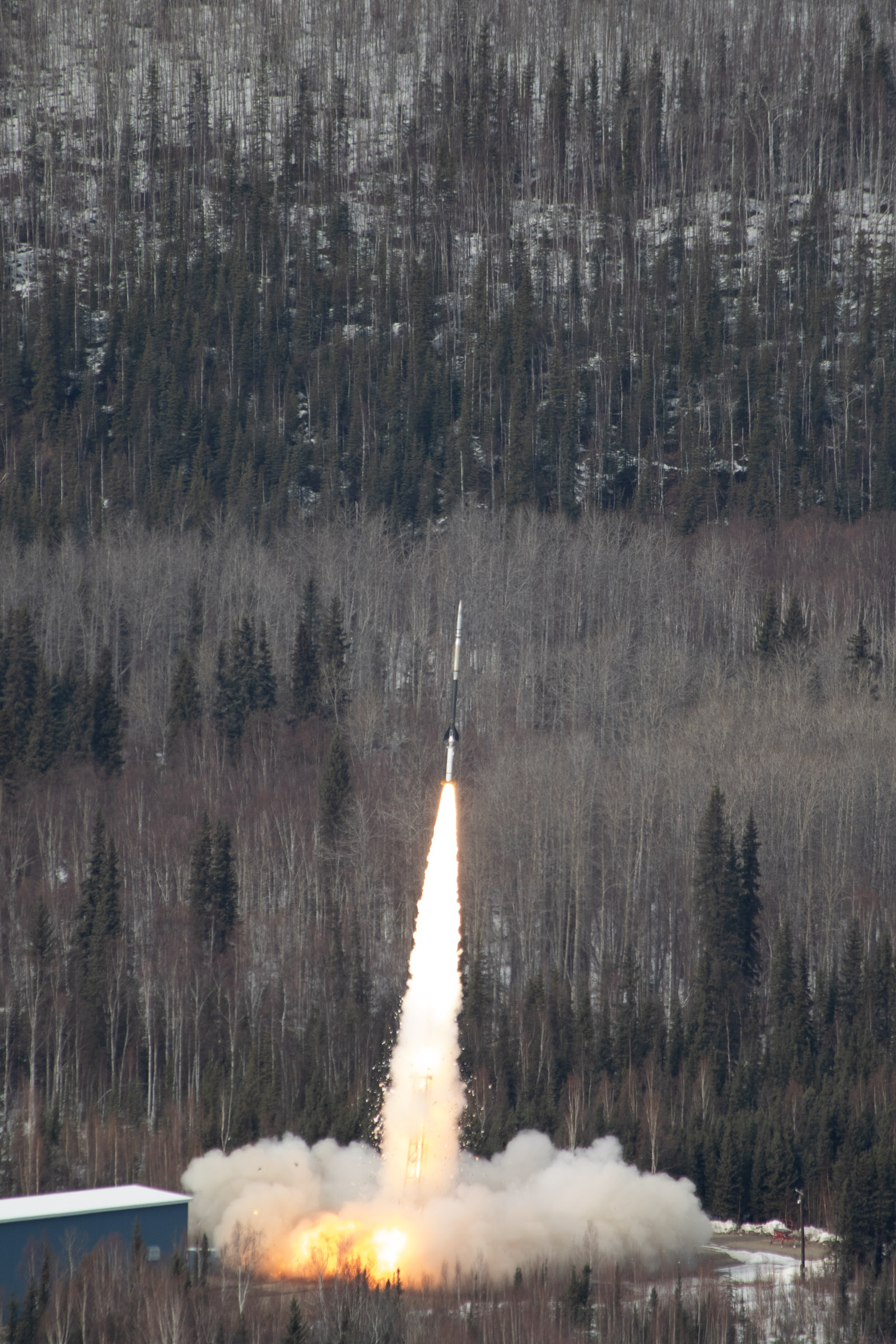
A Black Brant IX rocket left Poker Flat, Alaska, at 11:23 a.m. local time on 14 May 2026. Above most of the atmosphere, it had about five minutes of useful observing time. NASA and the University of Alaska report that it recorded three small flares in different parts of the Sun. That was the result of this particular campaign, not a promise that every future flight will see three events.
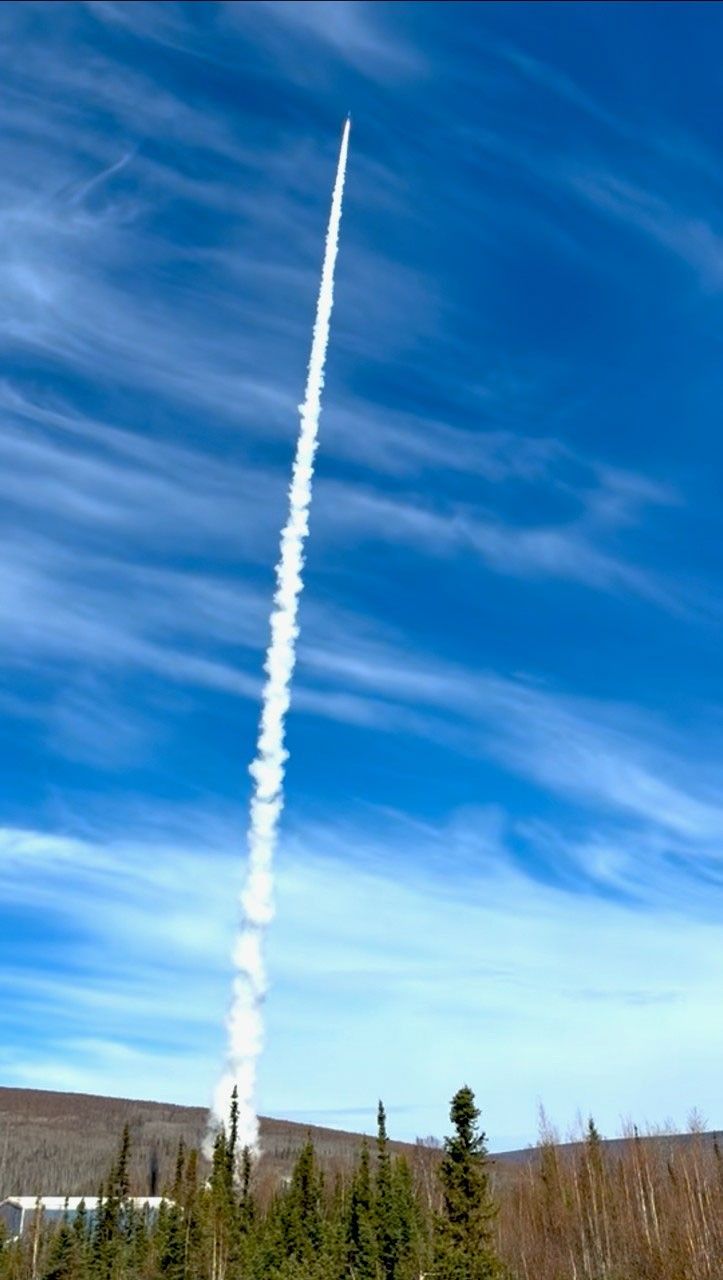
Poker Flat Research Range / NASA · Sources ↗ · Image terms ↗
The team had waited almost two weeks and was nearing the end of its launch window. Without an alert, the choice would depend much more on luck: launch too early and the instrument sees no flare; launch late and it misses the most revealing phase. That is why the precise purpose of the warning system matters.
What is a solar flare?
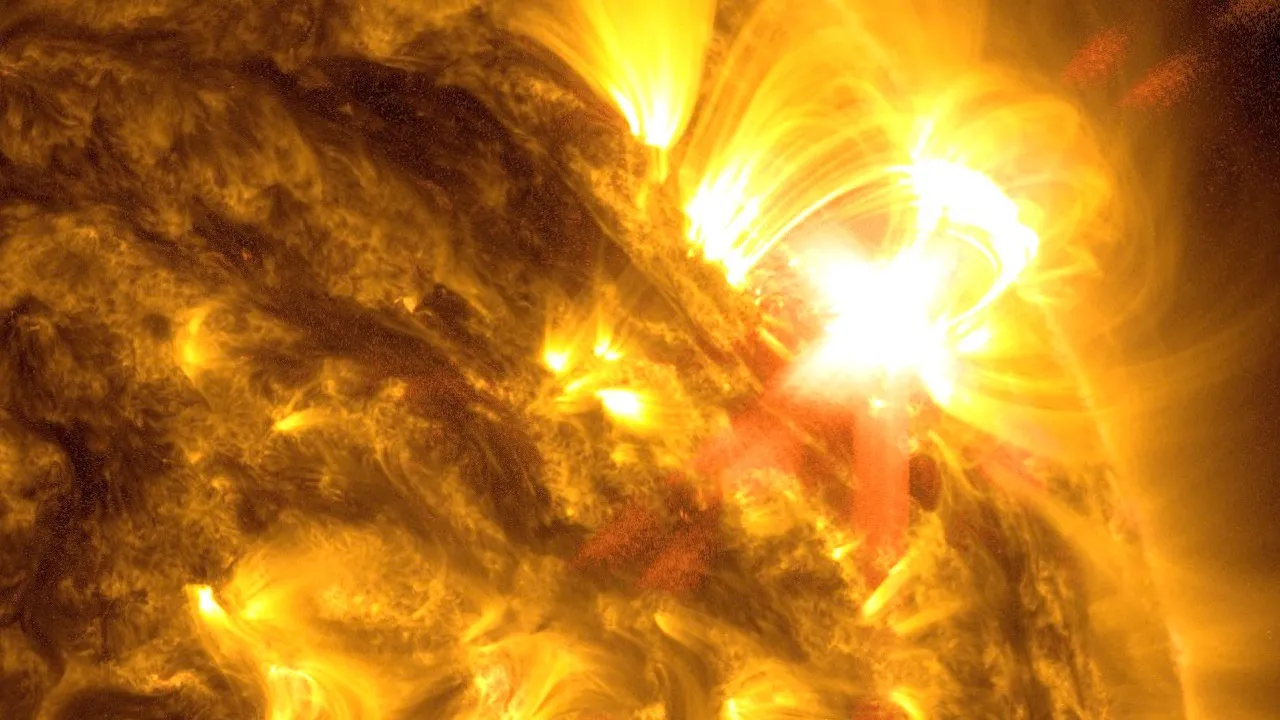
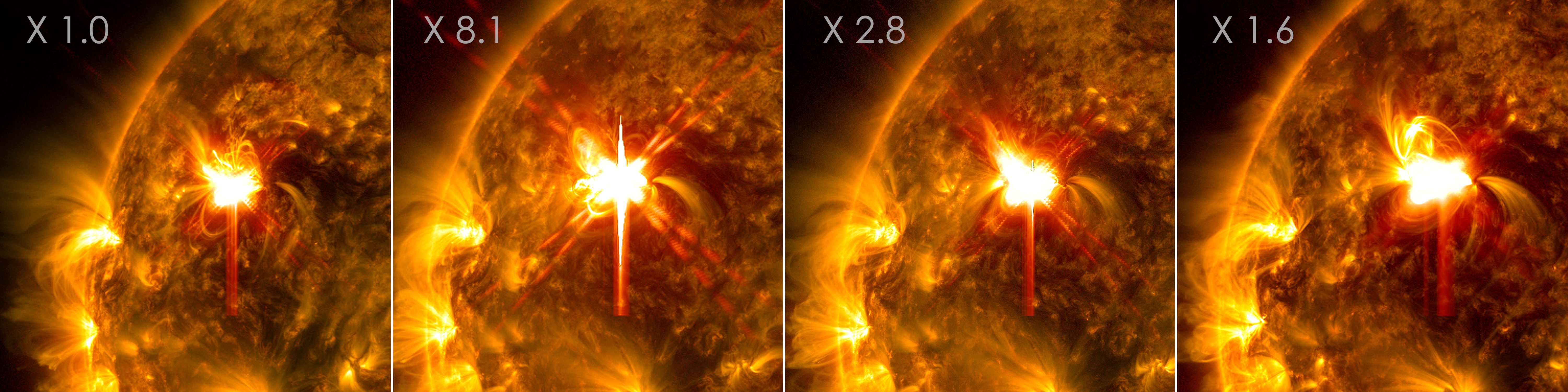
The Sun is not a motionless glowing ball. Its , a gas containing electrically charged particles, keeps moving while and rearrange. In above , magnetic energy can build up. When the abruptly, some energy heats the and accelerates particles. We observe the event as a : a brief surge of radiation, especially and .
A flare is not the same as a . The latter is a cloud of and magnetic field expelled into space. The two may occur together, but need not. Flare radiation travels at light speed and reaches Earth in about eight minutes; ejected material usually takes much longer. Earth’s atmosphere protects people on the ground from most harmful radiation, although strong events can disrupt radio links and satellites.
Flares are commonly classified A, B, C, M and X by their peak soft X-ray flux. Each step represents roughly ten times the signal, while a number after the letter gives a finer scale within a class. was not launched because a major storm had been guaranteed in advance. It sought scientifically useful measurements of actual events inside a narrow time window.
An alert for a flare already in progress
The system receives streams of observations from spacecraft and ground observatories. NASA’s , or , continuously images the Sun at several wavelengths and shows where activity is changing. ’s satellites monitor X-ray and ultraviolet radiation, revealing whether the signal is rising and how strong it is. Ground instruments add context. An algorithm uses these data to estimate the flare’s location and how much longer it might last.
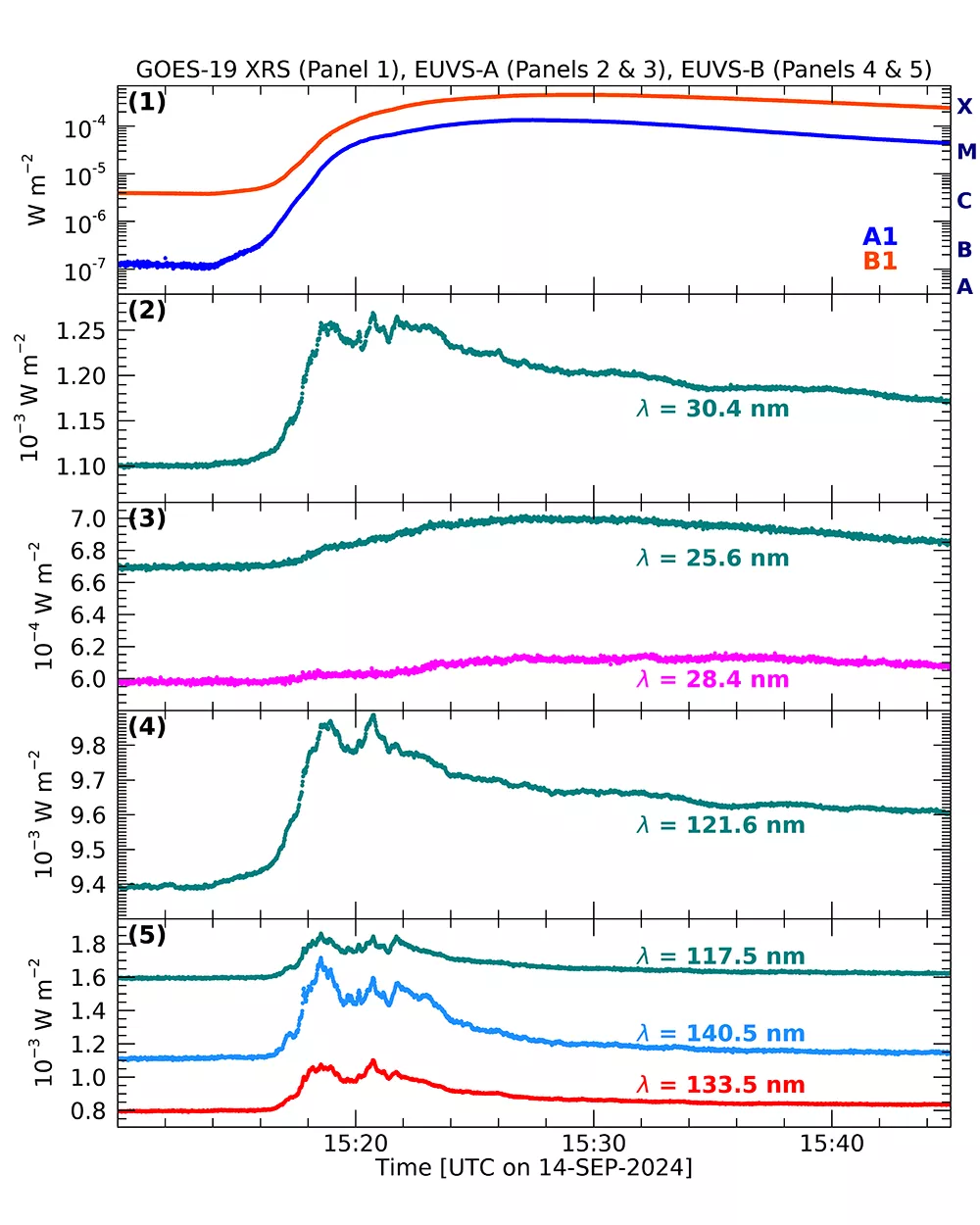
NOAA/NESDIS · Sources ↗ · Image terms ↗
This is an alert for a detected event and a short-term estimate of its development, not a precise calendar of future flares. Solar magnetic fields are complex, and there is currently no reliable way to name the exact minute of every eruption days beforehand. Even after a flare begins, its remaining lifetime is uncertain: one event may evolve differently from the examples on which a system was tested.
Software does not make the launch decision alone. Scientists and range operators must compare the alert with rocket readiness, weather and safety rules. The tool’s value is to turn many measurements into timely evidence for a human decision. It resembles weather radar showing a shower already forming and moving, rather than a promise that a storm will occur on one specified day.
Why a rocket when satellites already exist?
Satellites can watch the Sun for long periods, often nearly continuously. A sounding rocket flies briefly but can carry a specialised instrument that complements those data. Earth’s atmosphere absorbs most solar , so a ground telescope cannot observe them well. A rocket lifts its detector above the dense air for a few minutes and then returns.
stands for Focusing Optics X-ray Solar Imager. Its X-ray optics use mirrors struck at a very shallow angle. Ordinary mirrors would mostly absorb or transmit , while grazing-incidence mirrors can guide them towards a detector. This lets the instrument distinguish faint X-ray sources by position and energy. Researchers can then examine where is hottest and how energy moves during a flare.
NASA/SDO · Sources ↗ · Image terms ↗
Those observations complement imagery and radiation curves. A satellite may show that total is rising, while a focusing instrument locates the particular parts of an active region producing it. Combining instruments matters: one striking image alone does not establish how much energy was released or how particles transported it.
From the 2024 attempt to the 2026 flight
In April 2024, NASA launched two sounding rockets, -4 and Hi-C, about a minute apart during an M-class flare. followed , while Hi-C examined fine detail in . This was an important example of coordinating short flights with a transient event. The experience helped improve both the alert and the operating procedure for .
NASA / Lee Wingfield · Sources ↗ · Image terms ↗
In May 2026, the system helped the team choose a moment when detected activity might last long enough for the flight. The rocket caught three small flares. Their modest size does not make the data worthless: smaller flares also reveal how energy is released, and a sensitive instrument can resolve structures that coarser measurements blend together.
A study describing the alert appeared in The Astrophysical Journal in November 2026. A successful launch does not by itself settle the physics of . Researchers must calibrate the observations, compare them with other instruments and test whether models reproduce their evolution in time and space.
What does this mean for technology on Earth?
The launch alert answers a narrow question: is this a useful moment to send a rocket to observe a flare? It should not be confused with a public geomagnetic-storm warning that estimates possible effects on grids, navigation and satellites. The shared skill is rapid combination of trustworthy measurements from multiple instruments and clear communication of uncertainty.
Better understanding of how flares begin and move energy may eventually improve . That matters to astronauts, spacecraft and technologies dependent on radio signals. But years of additional observations and checks separate one successful five-minute observation from a reliable forecast of every dangerous event. shows the method particularly well: for a fleeting phenomenon, instruments, data and people have to work as one system.